

Rates and market · November 12, 2026
Phoenix and Tucson price cuts are not the same number
Arizona has two price-cut rates, not one. In Phoenix-Mesa-Chandler, price cuts were on 29.5% of listings in October, with a median list of $475,000, down 4.0%. In Tucson, cuts were on 24.1%, with a median list of $375,000, down 2.6%. A single statewide number would describe neither market.
The useful illustration is the payment on each metro's median list, labelled as an example, at a current rate. A Phoenix seller and a Tucson seller are not looking at the same competitive set, and a statewide talking point will get one of them wrong.
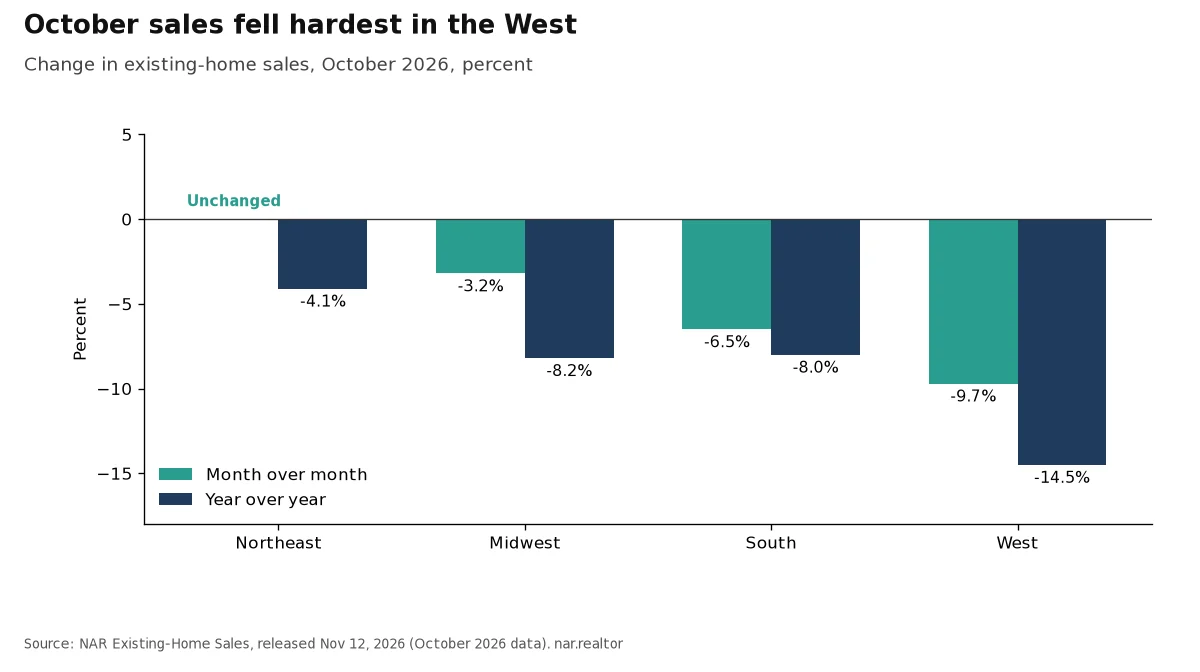
October sales fell hardest in the West. The two Arizona metros did not cut at the same pace
The National Association of Realtors reported on November 12 that existing-home sales fell 5.5% from September and 8.8% from a year earlier, to a 3.75 million seasonally adjusted annual rate, the lowest pace since August 2010. Lawrence Yun, NAR's chief economist, tied that drop to mortgage rates at their highest levels since 2000, aside from a single month in 2023.
Prices have not followed sales down. The median existing-home sale price was $416,700, up 0.4% from a year earlier, the 40th straight month of year-over-year increases. Distressed sales were only 2% of October transactions. Yun said the country's 88 million homeowners are "largely in a comfortable financial position due to sizable housing wealth accumulation."
Is it really the price, or is the market just dead?
On November 9 a homeowner put that question to other realtors. The house had been listed for close to six combined months. It was already the lowest by $10,000 among 12 similar listings, and it had had one showing in a month. Competing houses the poster checked were also getting no showings, after cuts and delistings that had not helped.
The poster had no need to move, was leaving only because of the weather, and asked whether a further $25,000 cut would be a poor decision. In the same stretch of road, the poster said, one nearby home listed and sold in a month for $400,000, and another went to foreclosure and sold for $310,000. Those two sales are one person's account, not official statistics. The poster's ask was $365,000, and the house had no driveway and only a side yard.
A small cut is not the same as a price that can sell
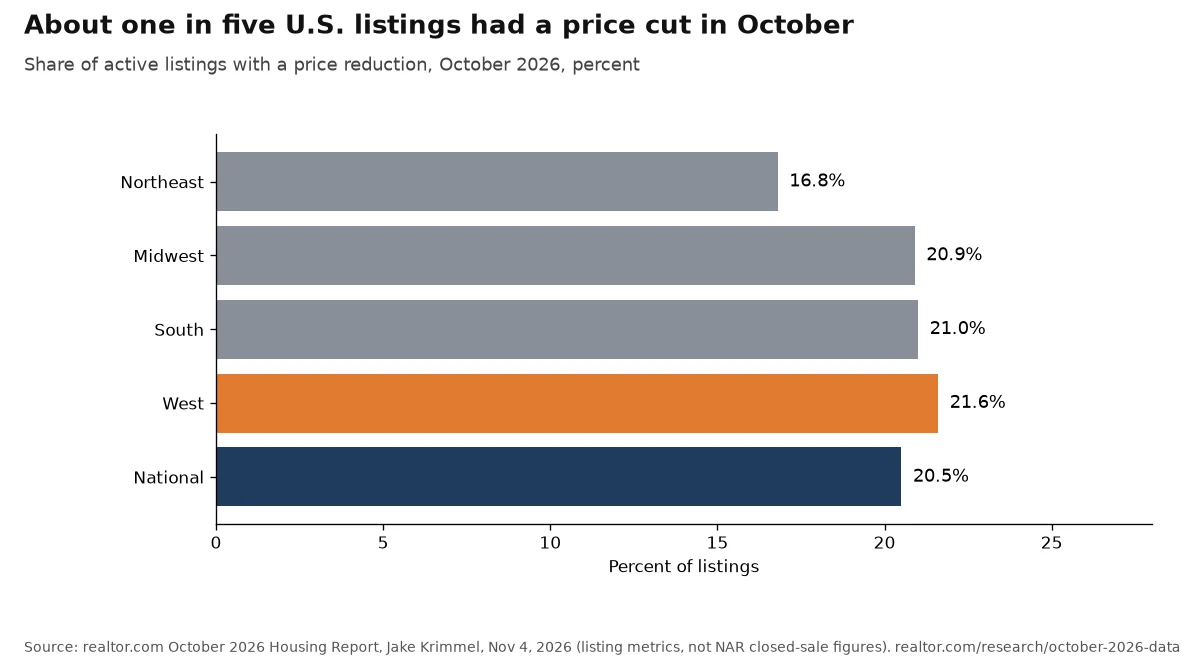
About one in five U.S. listings already had a price cut in October, 20.5%, according to realtor.com, only 0.2 points above a year earlier. Jake Krimmel, who wrote the report, put the mood in a heading: "Sellers freeze rather than panic." New listings fell 7.5% from a year earlier, the steepest drop since September 2023. The delisting rate was 4.4%, against 4.6% a year earlier.
A cut from an ask that was never realistic can look large and still change nothing. In a separate thread, a listing agent described a seller who treated a $70,000 drop as a huge concession, after the house had been listed about $70,000 too high because of an incorrect square-footage figure. The original price, the agent wrote, was never realistic to begin with. A token cut is not a strategy.
Agree on the checkpoint before the listing goes live
There is no single national figure for how many days should pass before a price change. One useful practice is to set the checkpoint in advance, so the later conversation is less personal. If showings in the first 10 days fall short of an agreed number, or if feedback keeps naming the same issue, the ask or the presentation gets another look. The trigger should be named before the sign goes up.
Two widely quoted clocks measure different things and should not be treated as a rule. NAR's median time on market for homes that sold in October was 35 days. realtor.com's median for listings was 63 days. One is a sold-home figure. The other is a listing figure. Neither tells a seller when to cut.
Show the seller a payment, not only a price
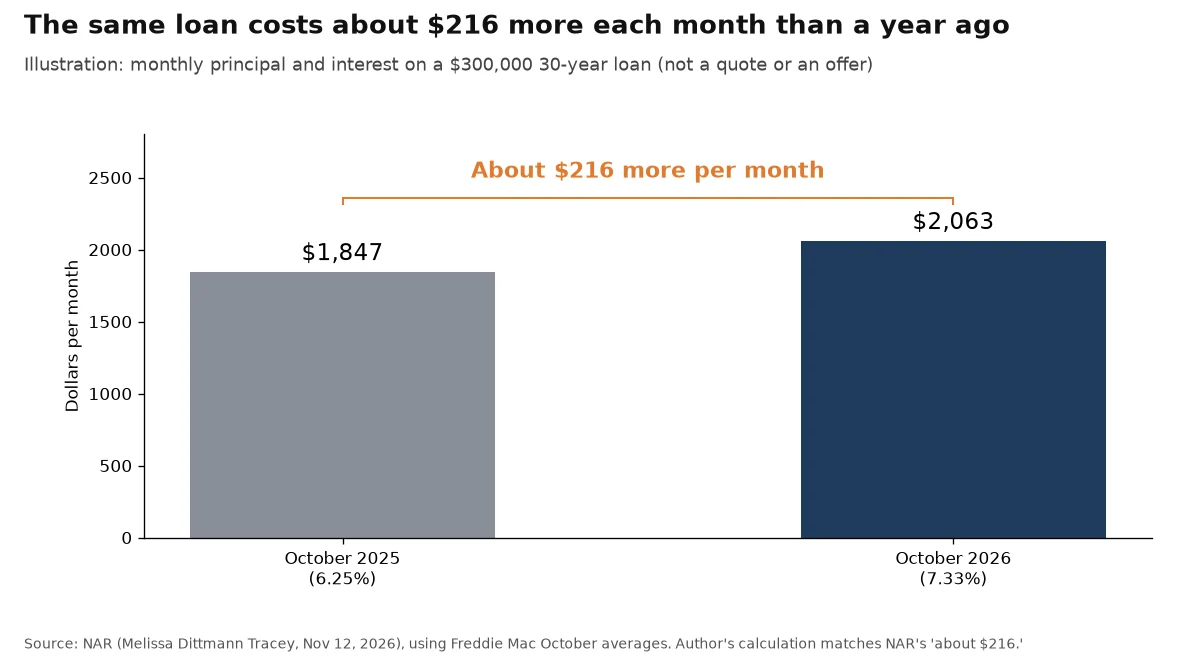
The most useful thing a loan officer can do for a listing agent is show the seller today's payment at the current ask, set next to the competing listings. NAR published a national illustration: on a $300,000 mortgage, the October average rate of 7.33% added about $216 a month compared with 6.25% a year earlier. That is an example, not an offer, and it is a national figure.
A labelled illustration on Phoenix's median list of $475,000, and a second on Tucson's $375,000, will differ from NAR's national $300,000 example. The method is the same, and each figure is an example, not an offer. Use the metro that matches the house.
On the buyer side, a verified pre-approval helps an agent write an offer a seller of a stale listing might actually answer. A low number without proof that the buyer can close is easier to ignore.
Many sellers can wait, and that is why some listings sit
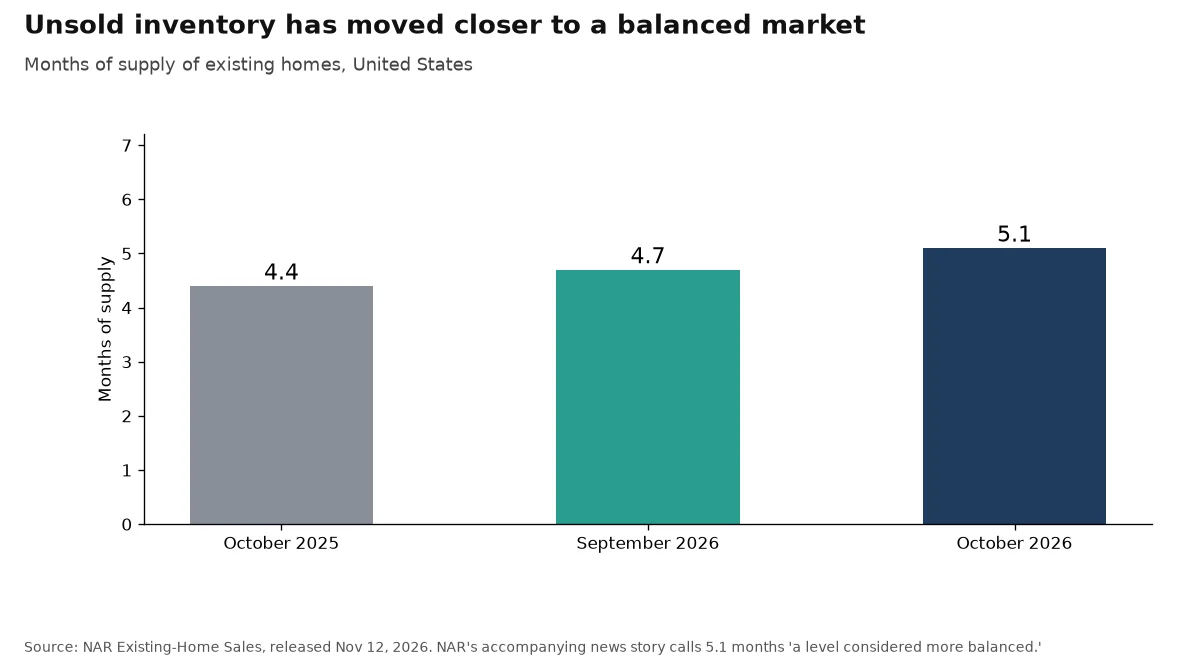
Yun's point about homeowners' equity, and the 2% distressed-sale share, explain a lot of the freeze. realtor.com's Krimmel put it bluntly: "you do not list into weak demand unless you need to." Sellers who can wait often do. The November 9 poster said outright there was no need to move. Unsold inventory has moved closer to a more balanced level: a 5.1-month supply in October, up from 4.7 in September and 4.4 a year earlier, which NAR's accompanying story calls "a level considered more balanced."
Waiting for rates to fall is a possibility, not a date
Yun said that, given the current sales pace at a time of consistent job growth, "there could be sizable pent-up demand if mortgage rates decline." realtor.com's base case is that rates "remain above 7% in the near term." Both statements are judgments about what might happen, not a calendar. If the seller needs to close, the ask still has to meet the buyers who are here now. If the seller can wait, waiting is a real choice, not a failure.
More reading: seller-paid 2-1 buydowns · Phoenix and Tucson mortgage pages · buy a home
If you're a listing agent, I can help you run that payment comparison for your seller. Start at homeloansbypaige.com.
This post is general education, not a loan offer. Paige Martinez, Licensed Loan Originator, NMLS #214634, AZ LO #0911340. Home Loans by Paige, LLC, NMLS #1913067, Arizona License #MB-1004864. Equal Housing Opportunity.
Photos via Wikimedia Commons: Skyline of downtown Tucson, Arizona by Sahmeditor, CC BY-SA 3.0; Downtown Tucson, Arizona, at sunset by Eapiwo, CC BY-SA 4.0.

Common questions
Why isn't my house selling after a price cut?
How many days on market before I should drop the price?
Is the housing market frozen, or are homes just overpriced?
Should I wait for mortgage rates to fall before changing the ask?
Let's talk about your plans
Whether you're buying, refinancing, or want a second look at a quote, tell me what you're hoping to do and I'll help you figure out the next step. If you'd rather start on your own, the Pre-Approval Checklist shows you what to gather.